THE CALL SHEET ✶ NO. 001 ✶ OMAR APOLLO ✶ THE CALL SHEET ✶ NNO. 001 ✶ OMAR APOLLO ✶ THE CALL SHEET ✶ NO. 001 ✶ OMAR APOLLO
ZAYFR
THE WRITING
ABOUT
SUBSCRIBE
NO. 001: OMAR APOLLO, THE COMMISSIONER
Most artists lose their specificity when the budget arrives. Omar Apollo hired four different teams across four countries and kept his, which says something about how he hires.
By Sergio Ramírez
· Founder · September 5, 2026 · 6 min
↗

Photo by Aitor Laspiur. Courtesy of Warner Records
I first saw Omar Apollo at the Greek Theatre in Los Angeles for the Prototype Tour. At the time, I had recently gotten into his discography and though I didn’t know much about him, I bought a ticket to his show as soon as it was announced.
I first saw Omar Apollo at the Greek Theatre in Los Angeles for the Prototype Tour. At the time, I had recently gotten into his discography and though I didn’t know much about him, I bought a ticket to his show as soon as it was announced.
It’s been four years since the show and while I don’t remember much, I remember it started with a red light shining on Omar as he performed “Ivory,” the first track from the album of the same name. A sparkly black suit, an electric guitar, and not much else. His features were hidden, but it was apparent from the crowd’s reaction to his mere silhouette that he was a performer through and through.
It’s been four years since the show and while I don’t remember much, I remember it started with a red light shining on Omar as he performed “Ivory,” the first track from the album of the same name. A sparkly black suit, an electric guitar, and not much else. His features were hidden, but it was apparent from the crowd’s reaction to his mere silhouette that he was a performer through and through.
I remember thinking how some of my favorite performers, specifically Lady Gaga, also opened their shows with a silhouette and allowed the energy from the audience to lead. For a young artist like Apollo, it was an ambitious decision and thankfully, he lived up to it. After “Ivory” came “Killing Me,” which, as far as I’m concerned, is his best song. I did not expect one young guy with a guitar to captivate the entire Greek. What stayed with me most, however, was that he built a stellar show from such minimal production. Even with the spectacle stripped away, you were still left with a one-of-a-kind show because Omar Apollo is a one-of-a-kind performer.
I remember thinking how some of my favorite performers, specifically Lady Gaga, also opened their shows with a silhouette and allowed the energy from the audience to lead. For a young artist like Apollo, it was an ambitious decision and thankfully, he lived up to it. After “Ivory” came “Killing Me,” which, as far as I’m concerned, is his best song. I did not expect one young guy with a guitar to captivate the entire Greek. What stayed with me most, however, was that he built a stellar show from such minimal production. Even with the spectacle stripped away, you were still left with a one-of-a-kind show because Omar Apollo is a one-of-a-kind performer.
Considering how he made it out of Indiana, it comes as no surprise that the same energy and ambition that got him out of there translates to his performing ability. He could not rely on money to carry his performance or to give him access to major photographers or production companies. His early work such as Stereo and Apolonio carries a charm you rarely see from artists who had industry backing from the start. The music video for “Kickback” takes place on a boat and shows Omar and his friends dancing along to the song. It’s just one example of a video that feels like it was recorded by someone who was already inside Omar’s ecosystem.
Considering how he made it out of Indiana, it comes as no surprise that the same energy and ambition that got him out of there translates to his performing ability. He could not rely on money to carry his performance or to give him access to major photographers or production companies. His early work such as Stereo and Apolonio carries a charm you rarely see from artists who had industry backing from the start. The music video for “Kickback” takes place on a boat and shows Omar and his friends dancing along to the song. It’s just one example of a video that feels like it was recorded by someone who was already inside Omar’s ecosystem.
We know how this story goes. An artist has a breakthrough, a song lands with the public, and the massive era arrives with label backing, real funds, and access to renowned photographers. Often though, that has been detrimental to the artistry. Artists with limited budgets are scrappy and resourceful, and that’s true of music the way it’s true of any commercialized art. Hand a hungry artist a real budget, and the resourcefulness that gave their work its charm is gone. The visuals become an afterthought, a mere means of marketing the album. To some extent, that is what a music video is for, but a video works when you leave it feeling like you’ve stepped into the artist’s world. If you leave feeling like it was phoned in, that’s when things feel generic.
We know how this story goes. An artist has a breakthrough, a song lands with the public, and the massive era arrives with label backing, real funds, and access to renowned photographers. Often though, that has been detrimental to the artistry. Artists with limited budgets are scrappy and resourceful, and that’s true of music the way it’s true of any commercialized art. Hand a hungry artist a real budget, and the resourcefulness that gave their work its charm is gone. The visuals become an afterthought, a mere means of marketing the album. To some extent, that is what a music video is for, but a video works when you leave it feeling like you’ve stepped into the artist’s world. If you leave feeling like it was phoned in, that’s when things feel generic.

Greek Theatre, Los Angeles
The Commissioner
The Commissioner
It is not unusual for an artist to have a visual director or one creative partner running through all of the work. I thought this was the case with Omar. For years, I assumed Omar had someone on his team guarding the creative direction, so researching this piece and finding out he doesn’t was a surprise. I pulled the credits off a few of his videos on YouTube and read the public call sheets. Looking through it all, I think Omar Apollo makes a great case for commissioning art rather than keeping one creative director.
It is not unusual for an artist to have a visual director or one creative partner running through all of the work. I thought this was the case with Omar. For years, I assumed Omar had someone on his team guarding the creative direction, so researching this piece and finding out he doesn’t was a surprise. I pulled the credits off a few of his videos on YouTube and read the public call sheets. Looking through it all, I think Omar Apollo makes a great case for commissioning art rather than keeping one creative director.
What’s most interesting about the call sheets is that they span four videos, four production companies, four countries and four unrelated visual grammars. As a viewer, you’d never know. You can watch all four videos and the quality, taste and tone are consistent to Omar.
What’s most interesting about the call sheets is that they span four videos, four production companies, four countries and four unrelated visual grammars. As a viewer, you’d never know. You can watch all four videos and the quality, taste and tone are consistent to Omar.
2023
Ice Slippin
rubberband. directing. SMUGGLER. Shot in London. DP Adam Newport-Berra. VFX by The Mill.
2023
Live For Me
Bandiz, Madrid. David Heofs. Two full crews, Los Angeles and Madrid, each with its own DP and art director.
2024
Spite
Bandiz again. Heofs again. Filmed in Mexico City, serviced by Rabbit House.
2024
Drifting
Keone and Mari Madrid. Los Angeles. A dance film, and Apollo is not in it.
The Two Names
The Two Names
A label creative services department has what I consider the most fun job in the building. In fact, I’d probably go as far as to call it a dream job if I keep going the corporate route. They take the brief, find the director, defend the choice internally, and hold the budget. They are a big factor in whether an artist’s videos come out memorable or generic. These teams are invisible by design, so it’s difficult to find anything about them unless you go looking. Two of them, though, were on the call sheets I read: Norman Wonderly, EVP of Creative Services at Warner Records, and Devin Sarno, VP of Creative Services. They’re on “Ice Slippin,” “Live For Me” and “Spite.”
A label creative services department has what I consider the most fun job in the building. In fact, I’d probably go as far as to call it a dream job if I keep going the corporate route. They take the brief, find the director, defend the choice internally, and hold the budget. They are a big factor in whether an artist’s videos come out memorable or generic. These teams are invisible by design, so it’s difficult to find anything about them unless you go looking. Two of them, though, were on the call sheets I read: Norman Wonderly, EVP of Creative Services at Warner Records, and Devin Sarno, VP of Creative Services. They’re on “Ice Slippin,” “Live For Me” and “Spite.”
Recurring credit
3 of 3 call sheets
Warner Records
Norman Wonderly, EVP, Creative Services
Warner Records
Devin Sarno, VP, Creative Services
Credited on
“Ice Slippin,” “Live For Me,” “Spite”
Management
Dylan Shanks, Jake Hicks
Transcribed from the official video descriptions
The music video for the lead single from God Said No, Omar Apollo’s follow-up to Ivory, went to a studio in Madrid. Bandiz was small and had no American major-label pop credits, and this was the opening statement of Omar’s biggest album cycle yet, which makes it an unusual call. Release calendars for Western artists are full of American commercial directors, and way too often the same artists link up with the same names. Joseph Kahn, Christian Breslauer, and Dave Meyers all come to mind. So reaching for an international talent nobody in the American pop system had called yet is an inspired move on its own, and it sets Omar apart from every major release that year.
The music video for the lead single from God Said No, Omar Apollo’s follow-up to Ivory, went to a studio in Madrid. Bandiz was small and had no American major-label pop credits, and this was the opening statement of Omar’s biggest album cycle yet, which makes it an unusual call. Release calendars for Western artists are full of American commercial directors, and way too often the same artists link up with the same names. Joseph Kahn, Christian Breslauer, and Dave Meyers all come to mind. So reaching for an international talent nobody in the American pop system had called yet is an inspired move on its own, and it sets Omar apart from every major release that year.
The Scans
The Scans
“Ice Slippin” came out in 2023 as the lead single from Live For Me, the follow-up EP to Ivory, coming right before God Said No. The song is about the winter Omar came out to his family and got, in his own words, cold judgment instead of acceptance. He has said the story about slipping on the black ice was real, inspired by a night his car started sliding off a highway in Indiana. Coming out is a subject that is rarely explored by mainstream artists, so I was curious to see how he’d handle it in the music video.
“Ice Slippin” came out in 2023 as the lead single from Live For Me, the follow-up EP to Ivory, coming right before God Said No. The song is about the winter Omar came out to his family and got, in his own words, cold judgment instead of acceptance. He has said the story about slipping on the black ice was real, inspired by a night his car started sliding off a highway in Indiana. Coming out is a subject that is rarely explored by mainstream artists, so I was curious to see how he’d handle it in the music video.
The credit list alone made it clear that this was not going to be the traditional sad pop video. It includes a heart imaging technician, a brain scan at Bright Brain Centre London, and an MRI through Allianz UK. It’s a decision the average viewer probably never thinks about, but in the context of the video, it does a lot of work. Artists tend to shoot metaphors for what is happening inside them. The team behind “Ice Slippin,” however, actually went through the work of capturing Omar’s insides.
The credit list alone made it clear that this was not going to be the traditional sad pop video. It includes a heart imaging technician, a brain scan at Bright Brain Centre London, and an MRI through Allianz UK. It’s a decision the average viewer probably never thinks about, but in the context of the video, it does a lot of work. Artists tend to shoot metaphors for what is happening inside them. The team behind “Ice Slippin,” however, actually went through the work of capturing Omar’s insides.
At the very least, the choice tells you how involved Omar is in his own work. It would have been easy to hand over a concept, let the production team take care of it, and show up on the day of the video shoot. Sitting for a brain scan is a deeper level of involvement, and it puts him at the center of his own video in a vulnerable position. I doubt the average viewer even registers that those are Omar’s scans, but that’s beside the point. What matters is the effort and involvement. Knowing Omar had authorship over it makes the work more compelling, and means his collaborators built the thing with him rather than telling him what to do.
At the very least, the choice tells you how involved Omar is in his own work. It would have been easy to hand over a concept, let the production team take care of it, and show up on the day of the video shoot. Sitting for a brain scan is a deeper level of involvement, and it puts him at the center of his own video in a vulnerable position. I doubt the average viewer even registers that those are Omar’s scans, but that’s beside the point. What matters is the effort and involvement. Knowing Omar had authorship over it makes the work more compelling, and means his collaborators built the thing with him rather than telling him what to do.
And when you look at the subject of the video, it resonates. It’s dark, gritty, and a little unsettling, but it is still an honest expression for Omar. It opens on the medical visuals, immediately giving you the sense that something is wrong. Brain scans and heartbeats, cut against the footage of Omar in negative light, fitting the X-ray logic of the whole thing. Then the video goes on to show photographs and videos from his childhood.
And when you look at the subject of the video, it resonates. It’s dark, gritty, and a little unsettling, but it is still an honest expression for Omar. It opens on the medical visuals, immediately giving you the sense that something is wrong. Brain scans and heartbeats, cut against the footage of Omar in negative light, fitting the X-ray logic of the whole thing. Then the video goes on to show photographs and videos from his childhood.

Cam Hicks
It’s intimate immediately, and it gets at the loneliness of being closeted without ever saying so. The experience is specific, but it’s the manner it’s told in, without hammering you over the head about what to feel, that lets audiences feel something looking at it, and as a result, it reaches people who never related to what the song is actually about. The video makes it feel like we were there when Omar went through the accident, and the archive footage from his own upbringing is so compelling that you can’t help but feel some kind of longing for him. And what’s more important here is that the video accomplishes a major function every video should strive for: it brings the fans closer to Omar. You leave with a clear understanding of him. He feels deeply, and he is extremely proud of his roots, his family, and his culture.
It’s intimate immediately, and it gets at the loneliness of being closeted without ever saying so. The experience is specific, but it’s the manner it’s told in, without hammering you over the head about what to feel, that lets audiences feel something looking at it, and as a result, it reaches people who never related to what the song is actually about. The video makes it feel like we were there when Omar went through the accident, and the archive footage from his own upbringing is so compelling that you can’t help but feel some kind of longing for him. And what’s more important here is that the video accomplishes a major function every video should strive for: it brings the fans closer to Omar. You leave with a clear understanding of him. He feels deeply, and he is extremely proud of his roots, his family, and his culture.
Madrid + Mexico City
Madrid + Mexico City
After Live For Me came Omar’s next proper studio album follow-up, God Said No. “Spite” was the lead single, and the video went to Bandiz, a Madrid-based production company founded in 2010 by David Heofs, a Spanish director and graphic designer who got his start making club flyers. The studio self-publishes zines and photobooks. Its roster is the Spanish alt scene: rusowsky, Ralphie Choo, Dellafuente, Lia Kali.
After Live For Me came Omar’s next proper studio album follow-up, God Said No. “Spite” was the lead single, and the video went to Bandiz, a Madrid-based production company founded in 2010 by David Heofs, a Spanish director and graphic designer who got his start making club flyers. The studio self-publishes zines and photobooks. Its roster is the Spanish alt scene: rusowsky, Ralphie Choo, Dellafuente, Lia Kali.
The video itself is a beautiful ode to Mexico City. You see the city in full saturation, Omar in his element, dancing in the colorful streets. Given how Mexican the video is, I was surprised to find out the creative team behind the video was Spanish.
The video itself is a beautiful ode to Mexico City. You see the city in full saturation, Omar in his element, dancing in the colorful streets. Given how Mexican the video is, I was surprised to find out the creative team behind the video was Spanish.
It gets even more interesting further down the call sheet. Some quick terminology for those who might not know: above the line means the roles that author a video. Think a director, a producer, a director of photography. Those roles were all Spanish. Below the line is the crew that executes it, and that crew for this video was Mexican, hired through a company called Rabbit House.
It gets even more interesting further down the call sheet. Some quick terminology for those who might not know: above the line means the roles that author a video. Think a director, a producer, a director of photography. Those roles were all Spanish. Below the line is the crew that executes it, and that crew for this video was Mexican, hired through a company called Rabbit House.
When a foreign crew shoots in another country, they hire a local service production company to run the shoot on the ground: permits, locations, crew, casting, everything that requires actually knowing the city. Rabbit House is that company. The motorcycle acrobatics shown in the video are credited to De Tránsito CDMX, meaning those are actual traffic police, which is impressive on its own.
When a foreign crew shoots in another country, they hire a local service production company to run the shoot on the ground: permits, locations, crew, casting, everything that requires actually knowing the city. Rabbit House is that company. The motorcycle acrobatics shown in the video are credited to De Tránsito CDMX, meaning those are actual traffic police, which is impressive on its own.
The video has two nationalities in it, and the split is fascinating. The team that shot Mexico City was Iberian and the combination is why it hits so well. Could Omar have gotten the same result hiring a Mexican team? No doubt. But there’s something to be said for capturing the beauty of the city, for bringing in a crew who can witness some novelty in it.
The video has two nationalities in it, and the split is fascinating. The team that shot Mexico City was Iberian and the combination is why it hits so well. Could Omar have gotten the same result hiring a Mexican team? No doubt. But there’s something to be said for capturing the beauty of the city, for bringing in a crew who can witness some novelty in it.
The biggest takeaway is that rather than hiring the houses that everyone else hires, Omar is finding people nobody has called yet, and that’s what keeps his work looking inspired and fun.
The biggest takeaway is that rather than hiring the houses that everyone else hires, Omar is finding people nobody has called yet, and that’s what keeps his work looking inspired and fun.




Spite, dir. David Heofs, Bandiz
Off the Call Sheet
Off the Call Sheet
The credits only take you so far. I don’t know, for example, how much of this is Omar and how much is Wonderly and Sarno doing their jobs well. Warner’s creative services department is on every one of these call sheets, and maybe that’s a testament to the strength of the team: you don’t get the sense that the shoots were put together by a marketing team so much as you feel like they were authored by Omar Apollo. That’s what every artist should want out of their team. If Omar drove it himself, kudos to him. If not, I don’t blame him because he’s already busy making bops.
The credits only take you so far. I don’t know, for example, how much of this is Omar and how much is Wonderly and Sarno doing their jobs well. Warner’s creative services department is on every one of these call sheets, and maybe that’s a testament to the strength of the team: you don’t get the sense that the shoots were put together by a marketing team so much as you feel like they were authored by Omar Apollo. That’s what every artist should want out of their team. If Omar drove it himself, kudos to him. If not, I don’t blame him because he’s already busy making bops.
Either way, it doesn’t matter. A commissioning pattern this consistent across three years and four countries doesn’t happen by accident. Taste this consistent reads like one person’s vision, which is why I’d be surprised to hear Omar wasn’t involved in the story his visuals are telling. Across all of it, it’s so clear he has a deep love and appreciation for art and his culture.
Either way, it doesn’t matter. A commissioning pattern this consistent across three years and four countries doesn’t happen by accident. Taste this consistent reads like one person’s vision, which is why I’d be surprised to hear Omar wasn’t involved in the story his visuals are telling. Across all of it, it’s so clear he has a deep love and appreciation for art and his culture.
Stay Hungry
Stay Hungry
When you watch these videos, you get a sense that each one is the best version of itself. Together, they make Omar’s visuals look as though they were curated by Omar, and that is the most interesting thing about the commissioning approach.
When you watch these videos, you get a sense that each one is the best version of itself. Together, they make Omar’s visuals look as though they were curated by Omar, and that is the most interesting thing about the commissioning approach.
I can’t help but feel that a fixed visual author would have cost him the authenticity of “Ice Slippin.” And Omar is a human, not a product. Sure, at the end of the day, the marketing teams at the labels are working on a product, but Omar’s position is such a delicate and vulnerable one to be in. Too often, we see the person shaping the work go on to narrate themselves as the reason it happened. Laurieann Gibson was Lady Gaga’s creative director and choreographer, a founding member of the Haus of Gaga, and she has spent the years since saying she built the brand from scratch and that the credit was the problem. To a less established, less rich artist, that can feel predatory. And as someone who likes consistency, I’m all for having a set creative director on the team, but it wasn’t until I did the research for Omar that I got a different perspective and could see why commissioning works better. Are there still people calling the shots behind the scenes at Warner? Sure. But the fact that those names aren’t public facing is part of why the work still reads as his.
I can’t help but feel that a fixed visual author would have cost him the authenticity of “Ice Slippin.” And Omar is a human, not a product. Sure, at the end of the day, the marketing teams at the labels are working on a product, but Omar’s position is such a delicate and vulnerable one to be in. Too often, we see the person shaping the work go on to narrate themselves as the reason it happened. Laurieann Gibson was Lady Gaga’s creative director and choreographer, a founding member of the Haus of Gaga, and she has spent the years since saying she built the brand from scratch and that the credit was the problem. To a less established, less rich artist, that can feel predatory. And as someone who likes consistency, I’m all for having a set creative director on the team, but it wasn’t until I did the research for Omar that I got a different perspective and could see why commissioning works better. Are there still people calling the shots behind the scenes at Warner? Sure. But the fact that those names aren’t public facing is part of why the work still reads as his.
It all goes back to money. When people in a creative field are given access to lots of it, they stop being hungry. Established teams stop being scrappy and the work gets less inspired. Omar’s fame and budget are both still climbing and he is still hiring hungry people.
It all goes back to money. When people in a creative field are given access to lots of it, they stop being hungry. Established teams stop being scrappy and the work gets less inspired. Omar’s fame and budget are both still climbing and he is still hiring hungry people.
“Te Maldigo” was directed by Luca Guadagnino, produced by Trent Reznor and Atticus Ross, with Apollo in a custom suit by Jonathan Anderson, LOEWE’s creative director and the costume designer for Queer, the film the song was made for. What’s most striking is that this was a song built to promote a movie, tied to a campaign and a director and a fashion house, and it still came out feeling very Omar, and like an evolution of his work.
“Te Maldigo” was directed by Luca Guadagnino, produced by Trent Reznor and Atticus Ross, with Apollo in a custom suit by Jonathan Anderson, LOEWE’s creative director and the costume designer for Queer, the film the song was made for. What’s most striking is that this was a song built to promote a movie, tied to a campaign and a director and a fashion house, and it still came out feeling very Omar, and like an evolution of his work.
What’s Next for Omar?
What’s Next for Omar?
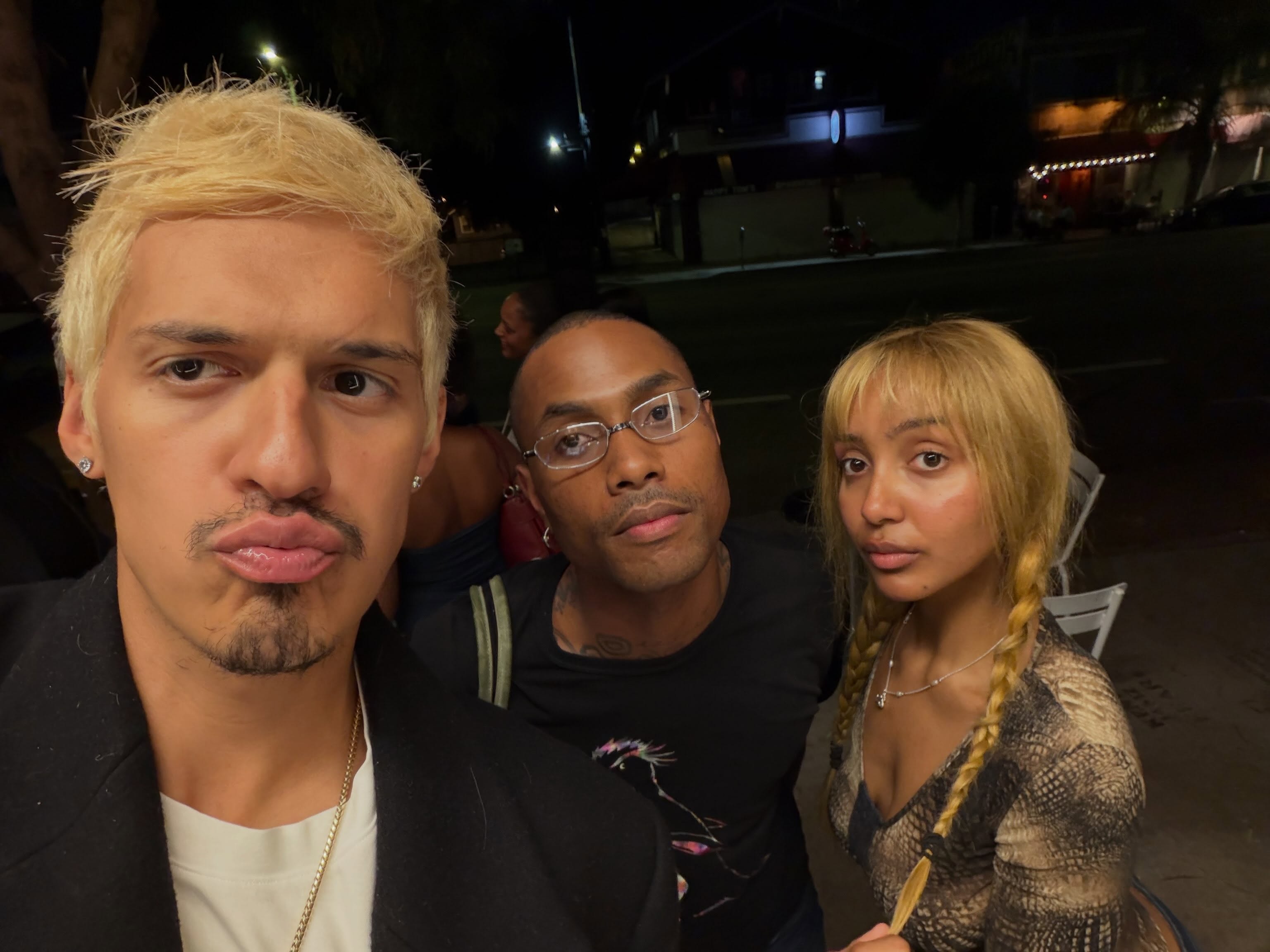
📷: Steve Lacy/Instagram
There is still no follow-up to God Said No, and I’m waiting on any kind of signal. Omar has been posting from the studio, and he’s been around Steve Lacy and PinkPantheress, so I would not be surprised to find either of them on a tracklist of his a year from now.
There is still no follow-up to God Said No, and I’m waiting on any kind of signal. Omar has been posting from the studio, and he’s been around Steve Lacy and PinkPantheress, so I would not be surprised to find either of them on a tracklist of his a year from now.
Years after that first night at the Greek, the thing I remember most is the subdued confidence Omar displayed. He still has it, and it shows up beyond the stage. It shows up in how he hires: more like a student than a teacher, surrounding himself with people who are having fun and inspiring him.
Years after that first night at the Greek, the thing I remember most is the subdued confidence Omar displayed. He still has it, and it shows up beyond the stage. It shows up in how he hires: more like a student than a teacher, surrounding himself with people who are having fun and inspiring him.
What I want to see is whether the next cycle commissions again or commits to one author. Whichever way it goes, it will be 100% Omar. ✲
What I want to see is whether the next cycle commissions again or commits to one author. Whichever way it goes, it will be 100% Omar. ✲
All credits in this piece were transcribed from Omar Apollo’s official video descriptions and the production companies’ own sites.

SERGIO RAMÍREZ
Founder and editor of ZAYFR, a music and culture publication in Los Angeles. He writes, shoots, and art-directs all of it.
Get it in your inbox
One email a week: the new piece, the show picks, the photos. ZAYFR is just getting started. Be here early.
ZAYFR ✶ EST. 2026 ✶ LOS ANGELES ✶ ZAYFR ✶ EST. 2026 ✶ LOS ANGELES ✶ ZAYFR ✶ EST. 2026 ✶ LOS ANGELES ✶
ZAYFR
Music as memory. A publication by one fan who cares too much.
THE WORK
The Writing
What’s Coming
About
Subscribe
© 2026 ZAYFR — all frames first three songs, no flash.
built on available light ✶