The first time the “Symphony” meme came across my TikTok feed, I had no idea who the artist behind the song was.
The connection did not land until months later, October 2024, when a friend had invited me to the Hollywood Bowl. Kygo was headlining and Larsson was his opening act. Her set included “Symphony” with vibrant, overstimulating footage of dolphins behind her, footage that could have been pulled straight out of the meme. Two thoughts came to me: 1) She sounds incredible. 2) Oh, she is the one who sings this. I had never seen an artist embrace a meme that publicly, on a stage that size, or with such little embarrassment about it.
✲
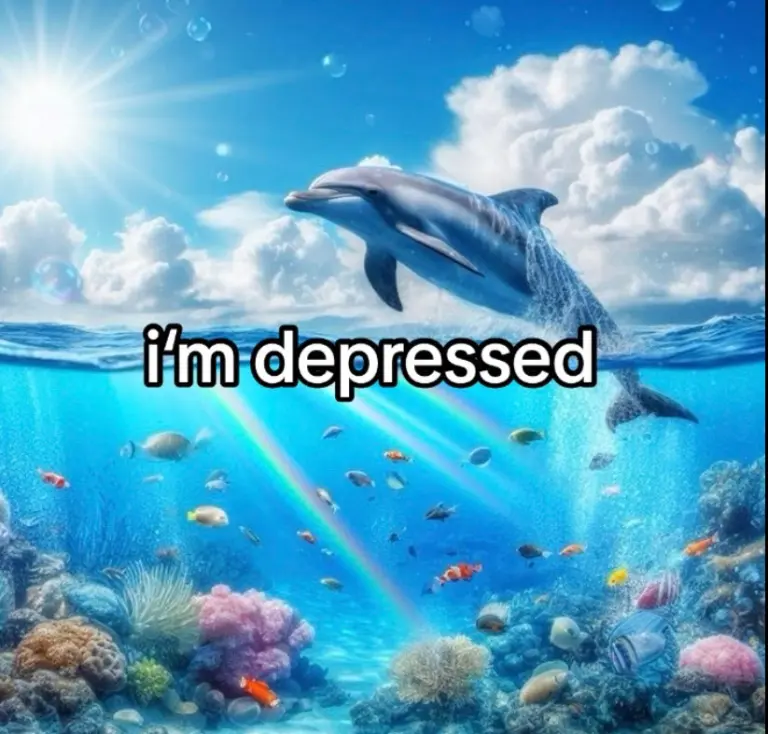
In 2024, the song “Symphony” started gaining virality, seven years after Clean Bandit released it with Zara Larsson on the hook. The format was simple: a dolphin arching out of a rainbow sea, oftentimes paired with a grim caption such as “I have crippling social anxiety.” The joy of the image contrasted against the flat and dark nature of the caption became the whole crux of the meme.
Midnight Sun album cover.
Symphony Dolphin meme, 2024. Artwork: Christian Riese Lassen, Enjoy Sunshine.
Most people called the dolphin Lisa Frank, but it was not Lisa Frank. The artwork used in the meme actually belonged to Christian Riese Lassen, a marine artist whose airbrushed whales and breaching dolphins have been hanging in mall galleries and cruise-ship gift shops for thirty years, while Lisa Frank made rainbow leopards for the school-supply aisle. Still, for anyone who grew up surrounded by Lisa Frank folders, binders, and pencil cases, the mix-up makes sense. The meme was speaking in a similar visual register, even if everyone was naming the wrong artist.
Larsson could have left the association there, as a funny piece of internet lore attached to an old hit. Instead, pieces of it started making their way into the world around the Midnight Sun rollout. Dolphins appeared again in the “Midnight Sun” video, now surrounded by hyper-saturated color, aquatic imagery, Y2K maximalism, femininity, and playful brightness. What had started as a meme began to look less like a viral moment Larsson was referencing and more like something that genuinely belonged to her.
Charlotte Rutherford shot the Midnight Sun visuals under Savannah Baker’s creative direction, and Rutherford’s register is high-key color, candy-saturated maximalism she had already been building in pop photography for over a decade. Rather than hire a photographer to imitate Lisa Frank, Baker hired one who had been working in that saturation range for years. That matters, because Midnight Sun already had its own candy-colored, high-key visual identity before Lisa Frank officially entered the frame.
Which is why, when Larsson released a limited-edition version of Midnight Sun with cover artwork by Lisa Frank, Inc. on September 26, 2025, it did not feel particularly random. The illustration featured all the expected Frank motifs: dolphins, flowers, musical notes, an underwater dreamscape with Larsson at its center. But by then, the internet had already associated Larsson with that colorful aquatic world, and Larsson herself had spent the rollout moving closer to it.
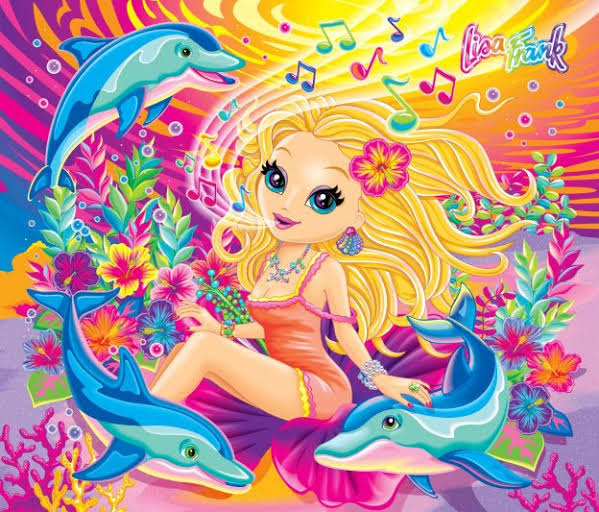
Zara Larsson, Midnight Sun (Lisa Frank Edition), 2025.
Artwork: Lisa Frank, Inc. Sommer House / Epic Records.
The meme had not invented color, femininity, Y2K maximalism, or fun for Zara Larsson. It had given people one extremely specific reference point for qualities that were already there.
Thinking from within a marketing team’s perspective, licensing Lassen only gets you the rights to the painting. Frank offered something different: an entire visual world people already recognized, one Larsson’s team could connect back to the meme without literally recreating it. Frank came with a whole history attached, which made the connection instantly legible.
That also makes the format of the collaboration worth noting. The Lisa Frank Edition of Midnight Sun is a physical CD in a custom O-card sleeve, which puts that visual language back onto something meant to be owned, collected, and held. Of course, variants move units. Pretending otherwise is stan-account behavior. But there is a meaningful difference between changing the color of a vinyl and bringing another artist into the authorship of the cover. One gives fans another version to buy, whereas the other can actually add to the world of the album.
The timeline is the part I keep coming back to. The meme peaked around 2024, and the collaboration did not arrive until September 2025. Most marketing teams at record labels and ad agencies would have pushed for a dolphin filter and a branded sticker pack within three weeks of the trend cresting, harvested the engagement, and had nothing left to attach to an album eighteen months later.
And listen, working in music, especially on the creative side, reactive is the name of the game. You oftentimes do have to move fast (two words that make me cringe, but that is an entirely different issue). What Larsson's team understood was how to recognize a moment without exhausting it immediately. They let the association hang around long enough for it to become useful somewhere bigger.
✲
In another world, with a different pop star and a different team, all of this could have looked incredibly tacky. A viral dolphin becomes an album aesthetic, which becomes an officially licensed Lisa Frank cover. Written out like that, I am honestly surprised it worked.
Pop marketing is full of examples where you can feel the mismatch immediately. An artist working in film grain announces a Hello Kitty variant. A rap album photographed in warehouse gray gets a candy-colored cereal-brand tie-in. The artist has one visual language, the IP arrives with another, and everyone can see the seam even if they cannot quite explain why. Those collaborations can generate an asset, maybe some headlines, maybe some enthusiastic stan-account posts, but they rarely add anything meaningful to the artist’s world.
The smartest partnerships are, in my opinion, the ones that already feel half-formed before any contracts have been signed. Something about the artist and the other brand is already overlapping. The label just has to recognize it, not flatten it into content, and trust audiences to spot the connection and have fun. After all, fandom on social media runs on ridiculousness and fun.
Lisa Frank was ultimately only one expression of what was happening with Zara. The bigger shift was that she and her team had started treating the things audiences responded to as material they could build from, rather than as jokes to cash in and abandon.
✲
Some would say Lisa Frank is nostalgia for the nineties, but I think the appeal is more specific than that. Lisa Frank lived on things you owned: folders, binders, stickers, pencil cases, objects you carried to school every day. The color was physical before so much of what we see became backlit and algorithmically served. There is also something appealing about returning to a visual world that is so aggressively cheerful at a moment when the actual one can feel increasingly grim. Lisa Frank offers dolphins, rainbows, stars, and absolutely no interest in restraint. That kind of maximalism feels especially potent now, after years of pop swinging between brat's institutional green and the washed-out neutrals of prestige-adjacent pop. Larsson went somewhere louder.
✲
Midnight Sun: Girls Trip arrived on May 1, 2026 with collaborations with artists like Shakira, Robyn, PinkPantheress and Kehlani. The cover is Larsson on a pink hot rod on an open road, shot by Rutherford again.

Zara Larsson, Midnight Sun: Girls Trip, 2026. Photography: Charlotte Rutherford.
Sommer House / Epic Records.
What I find curious is that neither album cover features any of the dolphin imagery that kickstarted this whole thing. A weaker team would have run the dolphin back because they had seen it work once, and by the third deployment the artist becomes a host body for other people’s intellectual property. Larsson used the joke once, at full strength, then moved to a different image with the same photographer and the same chromatic logic.
Part of the appeal was that fans felt like they were in on the joke with her. Push that too hard and it stops feeling like a joke at all, so Zara let it breathe. On her recent tour, inflatable dolphins started showing up in the crowd, brought in by fans who had taken the bit and made it their own. At that point, she did not need to keep reintroducing the reference. The crowd was doing it for her, which is usually how you know something has moved beyond a campaign beat and become part of the artist’s lore.
✲
What could have been a passing viral moment turned out to be formative for the public perception of Larsson as an artist.
It is also worth noting that this was the era when Larsson finally started breaking through in the U.S. in a way she had not before. Midnight Sun earned her a Grammy nomination for Best Dance Pop Recording and she returned to the Hot 100 after years of American indifference. I would not credit any of that to an art direction strategy, but taken together, it is hard not to see an artist for whom a lot of things had suddenly clicked at once.
There is a scene in Up Close, the Zara Larsson documentary Prime Video released in November 2025, where Larsson plays Midnight Sun for the label. The pressure in that room is legible: make music that sounds like Zara. Do not make faceless pop that anyone could have done. She was five albums into a career at that point and still had not broken through in America, which makes it pretty funny that a dolphin meme ended up being somewhere in the answer.
Now it is 2026 and Larsson is playing two back-to-back nights at the Greek. The conversation around her sounds completely different. “Has she always been this funny? Wait, she can sing. Wait, she can dance too.”
It would be inaccurate to hand the meme credit for all of that. A meme is a delivery mechanism and nothing more. It means nothing if the artist at the other end of it has no charisma, no humor, no personality to deliver. Larsson was already online, already funny, already willing to be in on a joke at her own expense. The format found someone who could hold it.
So what does Zara do next? I have no clue. All I know is that, for the first time, she gets to make an album for people who already know who she is. There’s something thrilling about that. After years of trying to arrive, Zara Larsson finally gets to decide where she wants to go.